


What a week!
Thank you for joining us for Captioning Awareness Week 2026 (9 to 15 November). This year we shone a spotlight on the captioned and live subtitled events happening across the UK, had an amazing panel discussing all things access in our webinar, celebrated the venues that are making access a priority, and launched something new called The Third Seat.
We started with one captioned show, The Duchess of Malfi, in 2000. Today we caption and subtitle around 1,000 arts and culture events every year. That’s roughly 3 accessible events happening somewhere in the UK every single day.
Introducing The Third Seat

Up to 1 in 3 adults in any audience could be deaf, deafened or hard of hearing. Many of them are missing out on live events, or not coming at all, because they can’t follow what’s happening on stage, or on a talk or tour.
The Third Seat is to make this missing audience visible. We’re inviting venues to be part of the change by offering captions and live subtitles. Rachael Salt, a deaf caption user, put it perfectly:
“It’s just so isolating when everybody gets the joke and you’re not in on it… Imagine that for a whole show you’ve paid for.”

Subtitles on at home. Why not at the show?
Do you watch TV with the subtitles on? If so, you’re in good company. YouGov recently published new research showing that 30% of adults now prefer to have subtitles on when watching TV and films, up from 28% in 2023. Some people use them to catch every word, some find they help with concentration, and for others it’s simply become a habit. Either way, subtitles are now a normal part of how lots of us watch.
What we’d love to see is that habit reflected in arts and culture too. At the moment, fewer than one in five venues offer captions, even though over a third of young theatre audiences say they’d like them. That’s why we’re encouraging more venues to bring the access people already enjoy at home into the theatre, the gallery and the lecture hall.
What does a great experience look like for deaf audiences?
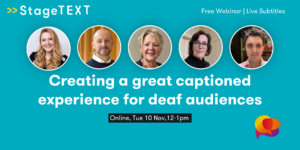 One of our highlights of the week was our Captioning Awareness Week webinar, where we asked a big question: what does a great experience look like for deaf audiences? With up to 1 in 3 people in any audience deaf, deafened or hard of hearing, we think it’s a question every venue should be asking.
Our CEO, Melanie Sharpe, was joined by Liam Steel, Laura-Jane Ferguson from Nimax Theatres, Kathryn McAuley from Nottingham Playhouse and Stagetext Ambassador Matt Fricker. They shared practical tips and real life examples, covering everything from caption display and seating to building captioning into everyday work and welcoming deaf audiences back again and again.
Out and about!
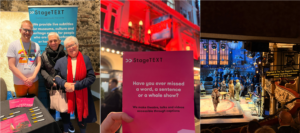
We loved getting out and about this Captioning Awareness Week! The Stagetext team hit the road and popped up at captioned events across the country, and it was so lovely to meet so many of you in person.
Thank you to everyone who stopped by for a chat, whether you told us what captions mean to you, asked a question or simply came over to say hello.
Missed us this time? Find a captioned show near you and we might see you there.
Captions are the missing piece my ears will never hear
Lots of people think theatre captions are made by AI. Stagetext ambassador Dawn says that’s not the whole story, and that AI just doesn’t get it the way a person does.
As Dawn explained, our skilled human captioners get names right, describe sounds clearly and, most importantly, make sure every line appears at exactly the right moment. For her, that means she can laugh when everyone else laughs and be moved when everyone else is moved.
Thank you
Stagetext is deaf-led, and we’re as passionate about quality access as ever. A big thank you to every venue that hosted captioned and subtitled events, and to everyone who came along to a show, joined our webinar, shared our posts or stopped by our stands. None of this would be possible without you.
Here’s to many more captioned and subtitled events in the year ahead, and we can’t wait to celebrate with you again at Captioning Awareness Week 2027.

