


Rachel Jele is head of advocacy and engagement at Stagetext, the UK’s leading charity for theatre captioning and live subtitling. Despite encouraging progress, she thinks captioning is still too often viewed as an optional extra.
I love culture. Give me an evening at the theatre, an author interview, a museum exhibition or a spoken-word performance and I’m happy. Like millions of people, I go because I want to be moved, challenged and surprised. I want to lose myself in the experience. But too often, I can’t.
As a deaf woman who has worn hearing aids since I was six years old, I know what it’s like to sit in an audience while everyone around me laughs, gasps or applauds at moments I’ve missed. I know the exhaustion of trying to lipread in dim lighting, or of reading a script beforehand just to keep up, or quietly asking my daughter “What did they say?”.
The arts sector talks passionately about inclusion. We celebrate diverse voices, broaden representation on our stages and work hard to reach new audiences. Yet accessibility is still too often treated as something separate from that conversation, something to add if budgets allow rather than something fundamental to whether people can participate at all. That has to change.
Too often accessibility is treated as an obligation
There are around 18 million adults in the UK who are deaf, deafened or hard of hearing. That’s one in three people. Many of us rely on captions or live subtitles to engage fully with performances, talks and events. Yet captioned performances remain relatively rare, and they’re often programmed as isolated access performances rather than being woven into a venue’s programme.
Too often, accessibility is treated as an obligation rather than an opportunity.
One of the biggest misconceptions is that British Sign Language (BSL) interpretation alone solves the problem. BSL is essential, and many Deaf people rightly depend on it. But deafness isn’t one experience.
I grew up in a hearing family and attended mainstream school. English is my first language, not BSL. For me, captions are what allow me to experience a performance alongside everyone else. Many people who lose their hearing later in life feel exactly the same. Accessibility isn’t about choosing one solution; it’s about recognising that deaf audiences are not a single, homogeneous group.
Accessibility isn’t about giving deaf people a special experience. It’s about giving us the same experience as everyone else. And increasingly, captions are benefiting far more people than many assume.
Perhaps we’re asking the wrong questions
Stagetext’s research found 42% of people use captions or subtitles to help them concentrate, while 54% regularly use them when watching television or online content. Almost one in four (24%) have already used captions at live events. What was once considered specialist provision is becoming an expected part of how audiences consume information.
Perhaps we are asking the wrong question. Instead of asking “Can we afford to caption this event?”, we should be asking, “Who isn’t here because we didn’t?”. Every inaccessible performance represents someone deciding not to come or attending knowing they’ll only experience part of what’s happening. It sends an unintended message that their participation wasn’t considered during planning.
The irony is that arts organisations are working harder than ever to attract new audiences while one of the country’s largest underserved audiences still faces barriers to taking part. Public appetite is stronger than many organisations realise. Previous research commissioned by Stagetext found that 77% of people support venues offering more captioned performances, while 31% said they would be more likely to attend live events if more captioning were available.
The benefits also extend well beyond individual organisations. Research continues to demonstrate the positive impact that accessible arts participation can have on wellbeing, reducing isolation, and improving social inclusion for deaf, deafened, and hard of hearing audiences.
An investment not a cost
At a time when every arts organisation is thinking about sustainability, accessibility should be viewed as an investment rather than a cost. The latest DCMS Participation Survey found that 91% of adults in England engaged with the arts at least once in the past year, while the cultural sector contributed £33 billion in gross value added in 2024, with DCMS sectors contributing £247.6 billion overall*. Theatre audiences also support local economies: for every £1 spent on a theatre ticket, a further £1.40 is spent on food, transport, and accommodation.Reaching more audiences doesn’t just benefit those individuals, it strengthens the cultural ecosystem as a whole.
I know the financial pressures are real. At Stagetext we work with remarkable organisations that are deeply committed to accessibility, often while balancing impossible budgets. Last year alone, Stagetext delivered 963 captioned and live subtitled performances, alongside many more delivered directly by venues and other providers.
That progress is encouraging. Yet we’re still regularly contacted after a season has been announced because accessibility wasn’t considered during programming or budget planning. Too often, deaf access is treated as something that can be added later if funding allows, rather than being planned from the outset. This tells us something important. Captioning is still too often viewed as an optional extra instead of part of the audience experience.
In Hamilton, Aaron Burr sings “I want to be in the room where it happens”. Well, so do I.
Not at a specially designated performance, held only on an afternoon with no option to attend an evening show – and not as an afterthought. Just in the room, following every word, laughing at the same jokes, sharing the same moments, and leaving with the same memories as everyone else. Because that’s what access is about: giving deaf people the same opportunity to experience culture, at the same time, and in the same way as everyone else.
*Department for Culture, Media and Sport (2025). DCMS Economic Estimates: Gross Value Added 2024 (provisional) and DCMS Participation Survey 2024/25.
Article originally on Arts Professional (behind their paywall): https://www.artsprofessional.co.uk/magazine/feature/who-gets-to-be-in-the-room
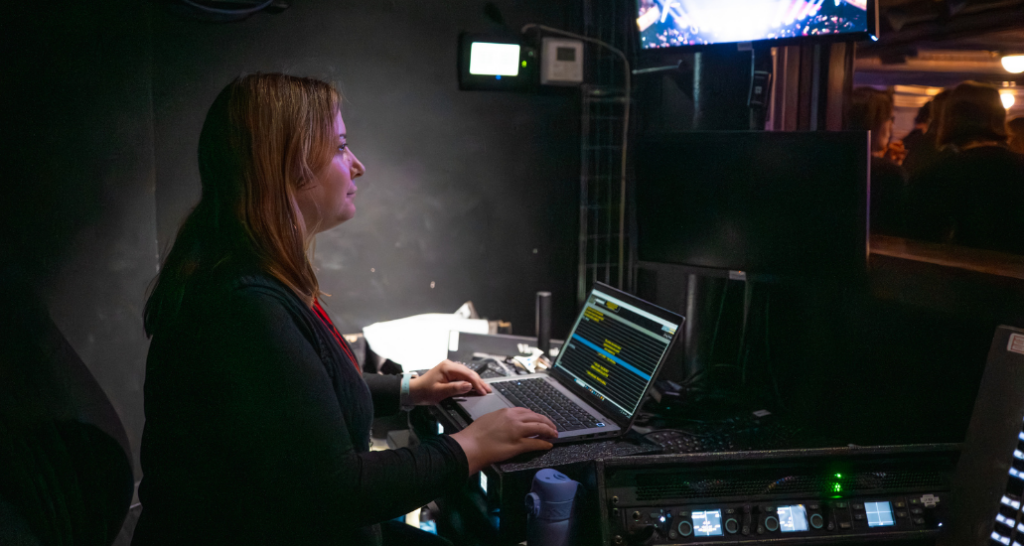
Photo: Malachy Luckie, captioning for Much Ado About Nothing at Theatre Royal Drury Lane

