


Response to queries on the tender – 14th May and 22nd May 2026
The following are responses to queries raised by potential suppliers following the publication of our Invitation to Tender for display screens for theatre captioning.
Please note, we have updated the Invitation to Tender to clarify its scope. This includes important updates on the budget and timeline. You can find the updated Invitation to Tender here.
Budget
We have budgeted £178,500 to purchase 34 large display screens and 30 small display screens, including the cost of flight cases and mountings. If submitting a tender for display screens only, please submit a proposal for no more than £124,000.
This budget is exclusive of VAT. The budget can be split as needed between large and small screens. There is no target per unit cost for each size.
Technical Specification
This is an open procurement to find equipment that best fits the purpose of captioning using our new software Stagetext+, which is owned by Stagetext. You can find more information about Stagetext+ here.
We acknowledge that the requirement for 1080p runs somewhat counter to the aspect ratio of the large and small screens requested. Readability is key, where a screen is ~16:3 (as described in the tender document) the vertical resolution is assumed to be approximate to that of a 1080p display, i.e. ~360 pixels. We acknowledge that a higher pixel density than P2 would be required to achieve this at 315mm screen height and welcome your proposals.
We have specified that LED displays are preferred, by this we mean an LED display screen such as OLED, rather than an LCD screen with an LED backlight. Other monitor display types can be considered on the proviso they support the low light operation requirements described i.e. the display must be able to go to complete blackout while powered on.
Our goal is a plug-and-play experience for captioners using standard laptops via HDMI. We will use HDMI splitters or occasionally multiple laptops to control multiple screens at the same time.
We wish to avoid the use of external custom adapters; the screen’s internal controller should handle the signal mapping directly from the laptop’s HDMI output.
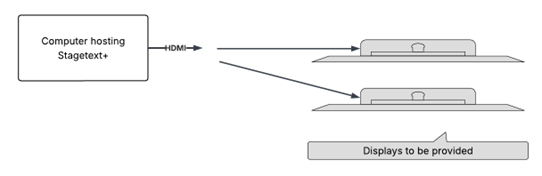 Whilst Stagetext+ can present to a number of different destination display types currently via the use of custom adapters, this tender seeks to identify screens that can be connected to a captioner’s laptop (a standard Windows or Mac computer) and the captioner’s laptop can display the content of a web browser on the destination displays with the aspect ratio and resolutions as described in the tender document.
We’d like the EDID to match the individual display screen exactly so that the graphics card on the computer hosting the Stagetext applications can determine how to best drive the display so that the entire display can be driven. The Stagetext application can output to a variety of display types, including browser-based interfaces which will be displayed on the displays.
We will consider screens outside of the dimension limits stated in the specification if they meet all other criteria. However, screens must still fit in a family car. The screens based at the hubs will most likely be transported in a van, but Stagetext’s own fleet of screens will be regularly transported individually and in pairs for one-off Stagetext shows, and our technicians use family cars.
The simplicity of set-up is a firm requirement. Screens are used for a matter of hours in each venue and need to be able to be set up and packed down in under 30 mins.
Ideally there will be no logo or splash screen on power-up, as a restart may need to happen mid-show.
The weight requirements in the technical specification do not include flight cases or mountings.
Flight cases and mountings
Each screen will need a fitted flight case with wheels and lashing straps for easy handling and transportation.
The screens will need back mounting and top mounting / brackets and semi-couplers in order for the screens to be hung or mounted onstage.
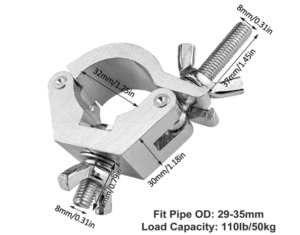 We use 35mm clamps to attach to theatre scaffold. An example is displayed here (see picture).
We occasionally need to use a 50mm clamp with same 8mm x 20mm screw attachment to screen.
If the successful supplier can provide display screens only, we will undertake a separate tender process for the flight cases and mountings.
Indicative timeline
Once the supplier has been chosen, we intend to purchase the display screens, flight cases and mountings for the project in batches. This will allow us to phase the rollout of display screens to each theatre hub.
The following timeline is indicative. It is based on a six-week turnaround from order to delivery to Stagetext.
| Date | Order |
| August 2026 | 6 large screens, 6 small screens |
| November 2026 | 4 large screens, 4 small screens |
| January 2027 | 4 large screens, 4 small screens |
| May 2027 | 6 large screens, 4 small screens |
| August 2027 | 4 large screens, 2 small screens |
| November 2027 | 4 large screens, 4 small screens |
| April 2028 | 6 large screens, 6 small screens |
| Total | 34 large screens, 30 small screens |
Please note, this timeline is solely for purchases relating to the DCMS funded project. We will be recommending the chosen supplier to theatres across the UK who may wish to purchase their own captioning equipment.
Technical Specification – additional responses 22nd May
- The large and small screens are specified as the same height (315mm) but of different length (1650mm and 1000mm), they will therefore have different aspect ratios – is this correct?
Yes, this is correct. We will consider screens outside of the dimension limits stated in the specification if they meet all other criteria. However, screens must be able to fit 3 lines of readable text and still fit in a family car.
- Do you envisage the large and small screens being the same resolution?
Ideally yes, but readability is key.
- Can Stagetext+ simultaneously output the same content to different resolution displays?
Yes, Stagetext+ can present to a number of different destination display types and resolutions.
- Screen connection – does a wired (ethernet) connection between the controller and sign meet your tender requirement?
Our goal is a plug-and-play experience for captioners using standard laptops via HDMI. We will use HDMI splitters or occasionally multiple laptops to control multiple screens at the same time. We wish to avoid the use of external custom adapters; the screen’s internal controller should handle the signal mapping directly from the laptop’s HDMI output.
- Does the EDID need to be pixel for pixel, or can the resolution be scaled?
The resolution can be scaled. The EDID does not need to report the exact physical pixel count of the screen, suppliers can design the system to report a larger resolution, as long as the aspect ratio matches the physical screen exactly to allow the controlling computer (usually running Windows) to output the correct shape of image, which the screen’s controller would then scale down to fit the physical display. The critical requirement is that nothing is cut off at the edges or distorted, which is ensured by keeping the aspect ratio correct.
Next steps
All information on how to respond to the brief is in the Updated Invitation to Tender. In the interests of fairness to all potential suppliers, we will not be responding to any further queries on the brief. The updated tender deadline is 9am on Tuesday 2nd June 2026.
Download Response to Queries 14 May as PDF
Download Response to Queries 22 May as PDF