


This Deaf Awareness Week, we’re looking back at where it all started.
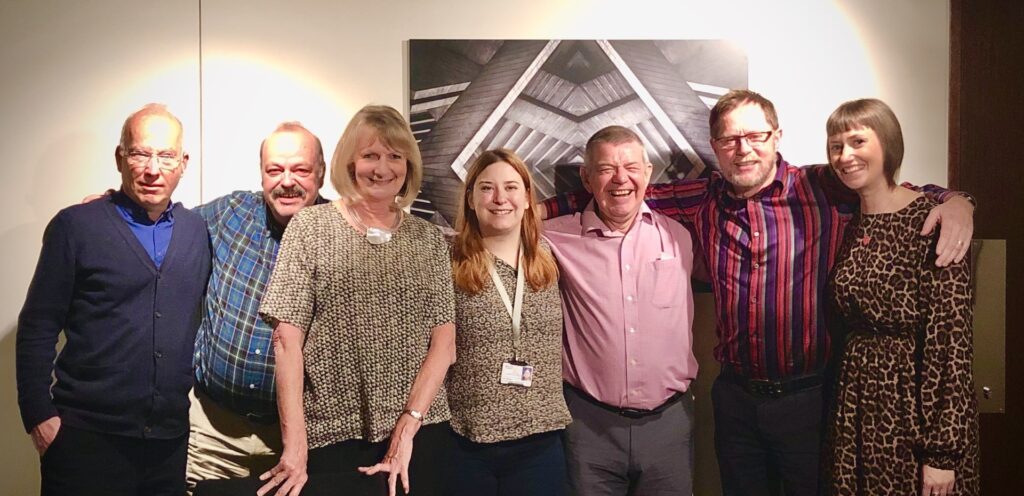
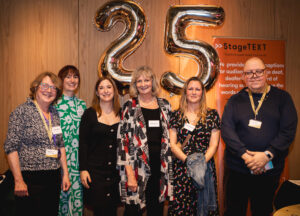
Last year, Stagetext celebrated its 25th anniversary. We were founded in 2000, the same year the Tate Modern and the Millennium Dome first opened. It was then that three deaf friends, Geoff Brown, Merfyn Williams and Peter Pullan, established Stagetext, trained Lynn Jackson in the art of captioning, and delivered the UK’s first ever captioned theatre performance.
What began as a small project by three friends has since transformed deaf access to theatre across the UK. To mark the occasion, we spoke with Co-founder Peter Pullan and Lynn Jackson, the first captioner for Stagetext, to discuss their memories, nerves and excitement from that night.
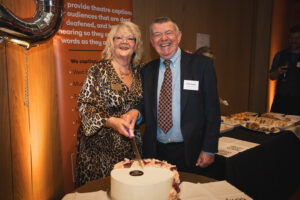
Peter Pullan reflects on the journey: “I feel very proud that we’re celebrating our 25th anniversary. We had no idea that it would go on for this length of time and we were delighted with the support given by Pat Collcutt, Access Manager of the Royal Shakespeare Company and Peter Cadley, London Theatre Manager of the Royal Shakespeare Company.”
Lynn Jackson recalls the early days: “I was very honoured to be part of it all. The excitement was palpable when we woke up to a double-page spread in The Guardian on the day of the first performance on 15 November 2000, announcing that you could see captions live at the Barbican. Our first performance involved inviting deaf and hard of hearing guests and deaf charities, and Pat Collcut and Peter Cadley were right there, supporting us.
I wasn’t as nervous for the first performance as I was for the ones after that. For the first two performances, Peter [Pullan] literally sat next to me, mopping my brow. It went very well and the response from deaf theatregoers was amazing. But for the first show outside London, in Stoke on Trent, I was on my own in the caption box and that was a bit nerve wracking!”
Lynn remembers what a difference captions made to audiences: “One deafened lady came to see Duchess of Malfi in London with her two hearing daughters. She recalled: ‘There I was, back in the magical world of theatre, able to follow everything that was said … It was pure magic.’ Another commented that having the captions made her really appreciate the poetry of the play. The reaction made it all worthwhile.”
The first captioned performance was not without its challenges. One actor pulled out at the last minute, forcing the team to adjust with very short notice.
Later, Lynn recalls the captioing in Stoke-on-Trent: “People were in tears because the captions had given then access to a play for the first time ever.”
Interest from other theatres soon followed. “It opened doors for further collaborations, including more talks at the RSC with Pat Colcutt, about potentially extending captioning to further performances in the next season.”
Quality makes all the difference
Peter notes the importance of precise timing in captioning: “The astonishing thing is, because I have some residual hearing, when the captions are perfectly timed, I can hear the actors’ words. Timing is crucial; it offers a very different and enhanced theatre experience.”
Peter reflects on why it matters: “The success of captioning depends heavily on the attitude of people in the theatre. For some, it doesn’t click immediately. But access should be tailored to the needs of the individual – it should include captions, loop systems, sign language interpretation, and other methods which should all be available.”
The quality of captioned performances has improved enormously. Lynn adds: “We established a training course and examination, working with Roz Chalmers, one of our very first captioners, and by the time I retired in 2016, captioning standards were excellent. I love hearing stories of friends attending captioned shows and being delighted by the experience.”
Actors have embraced captions too. Peter remembers that Tom Burke once remarked that caption units were “brilliant,” while Roger Allam, who was performing as Captain Terri Dennis in Privates on Parade at the Donmar, came out on stage and nodded in approval when he looked up at the caption box during a performance.
Twenty-five years on, Stagetext has made theatres, museums and galleries, talks and other events accessible for deaf, deafened and hard of hearing audiences, and shown the arts world how to include everyone. It comes from passion, hard work, and believing that everyone deserves to enjoy live performances together.
Read more about Stagetext’s work and impact today.
Want to know more of our story? Explore 25 years of Stagetext

